A Childhood Horror Story

A Childhood Horror Story

XvoQxOXhSCdelVbl[1]My children were probably 6, 8, and 10 at the time. We were moving our small sailboat boat from San Diego to Oceanside and were loading for the trip. The ten year old boy was stepping on with an armful of bedding, his Gameboy precariously perched on top of the pile. The Gameboy slid off when he was stepping up onto the boat from the dock and it fell into the water. Oh the horror! He reacted as if a limb had been severed, falling to the dock and wailing.

His eight year old brother wisely and immediately pushed his Gameboy further down into his back jean pocket. Unfortunately, during the continued provisioning, it worked its way back up and it too went into the water. Now we had a true family disaster to deal with.

Though I knew the electronics were likely irreparable, I dove in and retrieved the two games. We washed them with fresh water immediately and left them in fresh water until we later opened them and cleaned them. There is no happy ending, they were not resuscitated. We did learn some things about the inner workings of electronics, but it was a very small consolation to the two damaged youth.

I once dropped a cell phone in the water the day I bought it and paid extra to have the contacts transferred, remember those days?gb03_wash[1]

So what’s the best way to not experience this type of disaster? Prevention! Conscious forethought. Don’t put the “treasure” on top of the pile of clothes or in an otherwise precarious location. Note to self: use your wisdom to help your less experienced children and guests make smart choices. Ask yourself, do I really need to answer that call now? Can it wait until I am on shore or on the boat? We all drop our phones, usually they survive, but their survival chances are decreased on a dock. This is most relevant to live aboards and marine professionals who are often walking the docks.

If you do drop something at the dock, it is almost certainly retrievable. At the moment it enters the water, make a mental note of its physical location, i.e. five feet past the dock cleat. In many southern California harbors the bottom is mud and most objects drop straight down, sink slightly, but remain visible. If you are not a diver, there is often a diver in the marina, cleaning a boat, who is happy to make a couple extra bucks retrieving your treasure. The depth is often only 10 – 12 feet and easily reachable, don a mask (and perhaps a wet suit) and go get it. Contrary to popular belief, most people don’t get sick from swimming in the harbor.

If you are at anchor or adrift the recovery is much more challenging. If you are underway the odds are slim. If you have a weighted marker (float and weight connected with a line) ready to go, toss it. Noting a GPS location is not usually enough to recover an object without a lot of grid work searching and/or luck, but it is better than nothing. A floating marker buoy can also be used to mark an anchor and rode that won’t come up, so you can return and retrieve it later.

A final short safety reminder, in an emergency at sea, choose your VHF versus the cell phone as the mobile phone emergency operator will route your call to the Coast Guard anyway and you can save a few valuable moments by communicating directly with the first responder.

Three year old Captain

Three year old Captain

Mr. and Mrs. Johnson docked their 1988 60’ Egg Harbor Sportfisherman as they had many times.  They docked bow in, and secured the stern lines.  Mr. and Mrs. Johnson were walking forward to secure the bow lines, when the vessel lurched astern, breaking both stern lines.

As an immediate response, Mr. Johnson facilitated Mrs. Johnson’s attempt to board the vessel.  With her agreement, he launched her, she almost made it.

Mrs. Johnson made it onto the cockpit gunnel but did not make into the cockpit.  She fell into the water, grabbing a hold of the trailing stern line.

Mr. Johnson remembered a neighbor’s standup paddleboard stored on the dock nearby.

He hustled over, launched the board and paddled toward the still moving sportfisherman.  He approached the cockpit and attempted his own boarding.  Unfortunately, his attempt also failed and he ended up in the water holding onto the same line with his wife.  The vessel continued on an arcing course through Marina del Rey harbor.

The vessel eventually came to a sudden stop against a dock.

Mr. and Mrs. Johnson were able to climb out of the water and secure the vessel.

The accidental Captain was their three year old son.

Thankfully, there were no injuries and boats are repairable.

While the damage to the transom and cockpit deck was significant, this is the type of accident for which insurance is sold.

This true story caused the undersigned to reconsider old behaviors.  I have always left engines running until all lines are secured, thinking that I would prefer to have the engines available quickly.  In certain incidences turning the engines off once in the slip, may be more appropriate.  No doubt the Johnsons will alter their procedures and the family now has a story to tell forever.

Jet Lev

Jet Lev

So I am driving home last week, listening to the public radio station, and the economic reporter is using an analogy about jet packs. He says when he was a kid jet packs were the exciting invention for the future and we were supposed to have them readily available by now to fly over to a friend’s house. He said instead of jet packs we have the possibility of fueling our cars with algae, not as exciting.

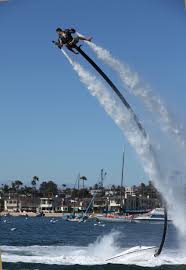
Fast forward a few days to Saturday, April 28, 2012. I am in Newport Harbor, Newport Beach, California. I am being transported on a tender from Balboa Island to a boat on a mooring near the car ferry (that runs from Balboa Island to the peninsula) to do a job aboard a boat on a mooring. The job is done and I get back in the tender and what do my child like eyes behold, a man on a jet pack.

My client, who is driving the tender, is unfazed and simply and calmly states, yeah he’s out here all the time. images[5]“What?” I exclaim! I absolutely must get a closer look, I am riveted and amazed. The jet flyer is hovering low to the water and then up 30 feet in the air. The flyer gets the attention of a small boat full of rambunctious young ladies and he returns the attention by tilting his water jet stream toward them in a flirtatious manner. The wisp of water spikes the volume of audible delight coming from the group in the boat.

I am equally rapt. I pull out my camera and plead for the operator to get me closer so I can take a picture of this flyer. He is cool. He is flying around Newport Harbor on a water jet pack. Finally a jet pack in action, tangible, practical? safe?…

I briefly researched the device on the internet this morning; it is called a Jet Lev R200. I assume the R200 is to make it sound science fiction-like or technological. On the Jet Lev web site the inventor, Raymond Li, is quoted “When I was 14 years old I saw James Bond fly a jet pack in the movie “Thunderball”, and have dreamed of flying one ever since.” Me too!

The Jet Lev Southwest (Newport Beach) web site (jetlevsouthwest.com) lists current pricing at $250 – $300 for the first flight and about $200 more for each further flight, where you can advance your skills to include “submarines” and “walk on waters”. The web site also uses words like, “safe” and “stable”, and phrases like “ease- of- use” and my favorite, “your dream of personal flight”.

That’s it, dreams of personal flight, just like Raymond Li, I have that dream and I am sure he and I are not alone. Sure most of those dreams did not include a jet pack, but now they might.

I continued my research and found out that there was an epic fail of the Jet Lev at a San Diego boatshow live on a Fox 5 San Diego TV news cast from July 2011 (http://gizmodo.com/5821541/dont-crash-your-jetpack-into-the-ocean-on-live-tv). The operator attempts to take off from the dock, bumps the reporter and then nose dives into the water. The news’ anchors reaction is hilarious and of course it brings up the question of safety, but the guy is out of the water and flying in an instant. The web site explains that he accidentally bumped the emergency kill button (as found on a personal water craft or small boat).

So in my exuberance, I tried to show my home made video to my two sons this morning. The 16 year old tells me he is sleeping and to go away. I don’t even get him to open his eyes when I bring the video to him on my lap top. My 14 year old is willing to watch my video and the professional videos on the web site, but has seen it somewhere in his “youtubing” in the past. Neither shares my enthusiasm; perhaps my 11 year old daughter will follow her dad when she gets home from her sleepover? My narration of my home made video of the jet flyer includes allusions to the Jetsons and Gilligan’s Island, lost on my children. Well I still have my shared (childhood) dreams with the announcer on PBS and I am certain that one warm summer day in 2012 I will be flying over Newport Harbor and I will pay the up charge for the Go-Pro video recording as a fond reminder and likely a great piece of personal comedic nostalgia for my children and theirs.